
Across the previous articles in this series, we've looked at each stage of a TOPCon wet process line individually — wafer texturing, single-side oxide etching, BSG removal, and alkaline polishing. This article walks through how those stages connect into a single continuous line, and why the sequence — not just the individual steps — is what determines final cell efficiency.
Step 1 — Alkaline Texturing
The wafer enters the line straight after saw-damage removal. Alkaline texturing uses KOH or NaOH to etch the (100) crystal plane of the monocrystalline wafer faster than the (111) plane, forming a dense field of random pyramids that will trap light once the cell is finished. Additive dosing controls pyramid size and uniformity, which matters not just for optical performance but for how evenly the next diffusion step proceeds.
Step 2 — Boron Diffusion, Single-Side Oxide Etching, and PSG Removal
After texturing, the wafer goes through boron diffusion to form the front emitter, and separately through the process steps that build the rear tunnel oxide and polysilicon layer. Single-side oxide etching and PSG removal clear phosphorus-doped glass associated with the rear n-type structure without disturbing the front side — the selectivity requirement that makes this equipment more specialized than a standard immersion clean.
Step 3 — BSG Removal
With the front emitter formed, BSG removal clears the boron-doped glass layer from the front surface only, leaving the rear polysilicon and passivation structure untouched. Because BSG is denser than PSG, this stage typically runs a different etch dwell time and chemistry concentration than the PSG step earlier in the line, even though both use similar chain-type single-side etching equipment.
Step 4 — Alkaline Polishing and RCA Cleaning
Once both glass layers are cleared, alkaline polishing smooths the wafer surfaces — rounding sharp pyramid tips and reducing surface area — to prepare a clean, uniform base for passivation. RCA cleaning follows in the same multi-cassette system, removing particulate and metallic contamination immediately before the wafer moves into deposition.
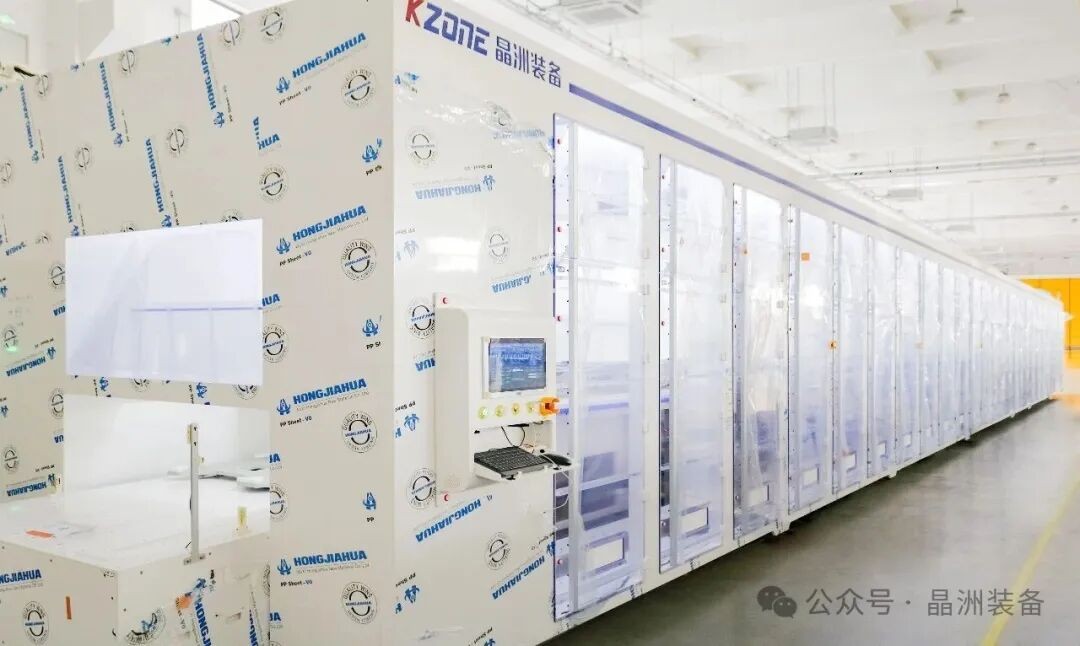
Each of these stages depends on the one before it: uneven texturing propagates into uneven diffusion; incomplete BSG or PSG removal blocks passivation from bonding correctly; over-aggressive polishing can erase the pyramid structure texturing worked to create. Running these stages as an integrated line, rather than as separately sourced standalone tools, is what lets a manufacturer hold a single throughput target across all of them. Kzone's integrated 1GW TOPCon wet process solution pairs chain-type single-sided etching at 5.0+ meters per minute with six-cassette alkaline polishing and RCA cleaning, engineered together for a total line capacity above 18,000 182mm wafers per hour.
Texturing, etching, BSG/PSG removal, and polishing aren't independent steps — they're a single connected sequence where a problem at one stage tends to surface as an efficiency loss several steps later. To review the complete line or a specific stage in more depth, explore Kzone's PV Industry Solutions, or contact Kzone's engineering team to discuss a full wet process line for your TOPCon production target.