
Two Routes to a Low-Reflectance Surface: Alkaline vs Acidic Texturing
Every crystalline silicon cell needs a textured surface to keep reflectance low, but the chemistry used to get there depends on the wafer's crystal structure. Monocrystalline wafers are textured with an alkaline process, while multicrystalline wafers — whose grains face in many different directions — are textured with an acidic process. Both aim at the same outcome, a light-trapping surface, but the mechanisms, equipment, and resulting cell architectures they support are quite different.
How Alkaline Texturing Forms Random Pyramids on Mono Wafers
Alkaline texturing relies on the anisotropic etch behavior of potassium hydroxide (KOH) or sodium hydroxide (NaOH) on monocrystalline silicon. Because these solutions etch the (100) crystal plane much faster than the (111) plane, the reaction self-organizes into a dense field of random upright pyramids across the wafer. Texturing additives are used to control pyramid nucleation density and size, which keeps the surface uniform from wafer to wafer and from batch to batch. The result is a highly directional, geometrically defined surface that suits the single-crystal structure of mono wafers.
How Acidic (Isotropic) Texturing Works on Multicrystalline and Black Silicon Wafers
Multicrystalline wafers can't rely on crystal-plane etch selectivity, since each grain within the wafer is oriented differently. Instead, acidic texturing uses a mixture of hydrofluoric acid (HF) and nitric acid (HNO3) to etch the surface isotropically, producing a shallow, rounded micro-texture rather than pyramids. A variant of this approach, often called black silicon texturing, uses metal-catalyzed or plasma-assisted acidic etching to create finer nanoscale structures with even lower reflectance, at the cost of a more complex and typically more expensive process.
Reflectance, Uniformity, and Process Cost Comparison
Alkaline pyramid texturing on mono wafers generally achieves lower baseline reflectance with a simpler, well-understood chemistry and lower reagent cost than acid-based processes. Acidic texturing trades some of that simplicity for the ability to process multicrystalline material at all, since alkaline etching on multi-Si would produce a highly non-uniform, grain-dependent surface. Black silicon acid texturing can push reflectance even lower than standard alkaline pyramids, but the added process complexity and chemical cost mean it's typically reserved for cell designs where the efficiency gain justifies it.
Why N-Type TOPCon Cells Rely on Alkaline Texturing
TOPCon cells are built on N-type monocrystalline wafers, which puts them squarely in alkaline texturing territory. The pyramid structure formed here has to be uniform enough to support consistent boron diffusion in the next stage, since an uneven textured surface can translate into uneven junction depth and localized efficiency losses that are difficult to trace once the wafer has moved further down the line. This is why alkaline texturing is specified as the entry stage of TOPCon wet process lines, feeding directly into single-sided BSG removal and alkaline polishing further down the process.
Choosing the Right Wet Process Line for Your Wafer Type
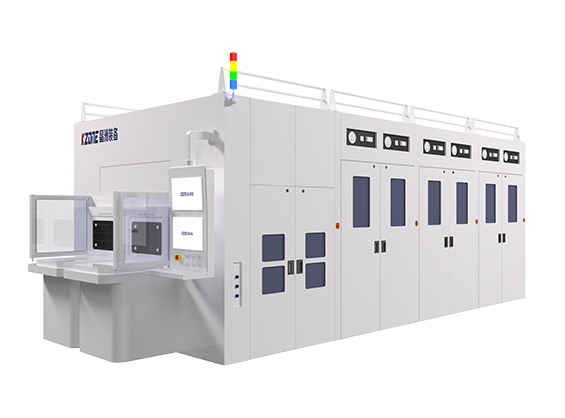
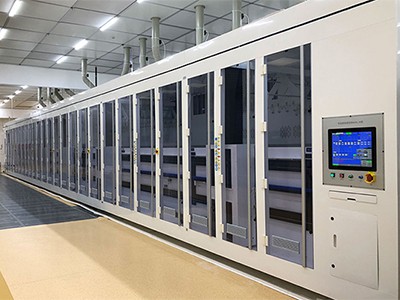
For manufacturers running N-type mono or TOPCon production, the practical question isn't alkaline vs acidic in the abstract — it's whether the texturing cleaner can hold bath temperature, KOH/NaOH concentration, and additive dosing tightly enough to deliver a consistent pyramid structure at full line speed. Kzone's alkaline texturing equipment is built as part of a complete TOPCon/PERC wet process solution, so texturing, diffusion protection, BSG removal, and polishing stages are matched to the same throughput target rather than specified separately.
Conclusion
Alkaline and acidic texturing solve the same optical problem through very different chemistry, and the right choice comes down to wafer type: alkaline for monocrystalline and N-type TOPCon material, acidic for multicrystalline and black silicon variants. To review equipment options for an alkaline texturing line, see Kzone's PV Industry Solutions or get in touch with Kzone's team for a process-specific recommendation.