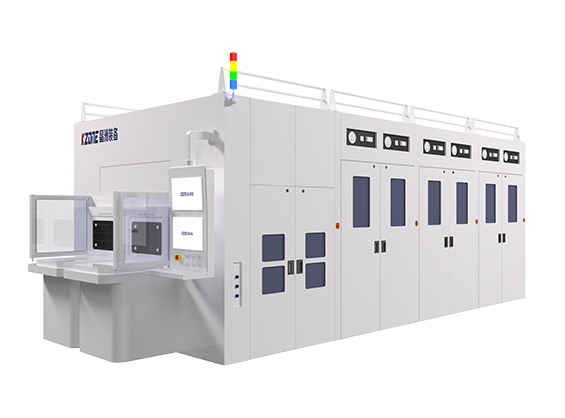

BSG stands for borosilicate glass, the byproduct layer that forms on the surface of a wafer during boron diffusion. As boron atoms are driven into the silicon to create the emitter, the diffusion furnace leaves behind a thin glass layer containing boron oxide. This layer isn't part of the finished cell structure — left in place, it interferes with subsequent deposition, passivation, and metallization steps, so it has to be removed cleanly before the wafer can move forward.
BSG differs from PSG (phosphosilicate glass, the equivalent byproduct of phosphorus diffusion) in that it tends to be denser and harder to etch. A boron-doped glass layer generally requires more aggressive HF-based chemistry or longer etch times to fully clear than an equivalent phosphorus-doped layer, which is one of the reasons BSG removal is treated as its own dedicated process stage in TOPCon lines rather than folded into a generic cleaning step.
In a TOPCon cell, boron diffusion forms the front-side emitter, so BSG removal sits directly after the diffusion furnace and ahead of alkaline polishing and RCA cleaning. Because the polysilicon layer and rear-side passivation stack are already in place by this point, the etch has to be single-sided — clearing the BSG from the front surface without attacking the rear poly-Si or wrapping around the wafer edge. Any wraparound etching at this stage can damage the rear passivation and create shunting paths that show up later as efficiency losses at cell test. This single-sided requirement is what distinguishes BSG removal equipment from a standard immersion clean, and it's why BSG removal is specified as a distinct stage within the TOPCon/PERC wet process solution rather than combined with texturing or general rinse steps.
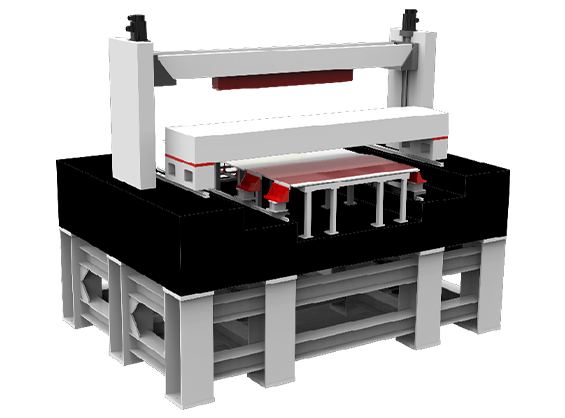
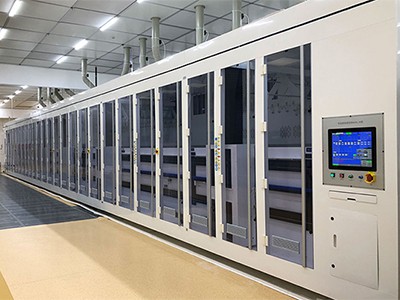
The industry has converged on two broad approaches to single-side BSG removal: chain-type inline etching, where wafers pass horizontally over a controlled HF liquid film on rollers, and batch alkaline-etch systems that use a front-side protective mask while the rear is etched in a KOH bath. Chain-type inline systems tend to offer higher throughput and a smaller footprint per unit of capacity, since wafers move continuously rather than in cassette batches, but they place tighter demands on liquid film uniformity and etch-roller precision to keep the etch confined to one side.
Both approaches aim for the same outcome — a fully cleared front surface with no damage to the rear structure — but the equipment engineering behind them is quite different, and mixing an under-specified tool with a high-throughput TOPCon line is a common source of yield variation.
A few design factors determine whether a BSG removal tool holds spec at production volume:
1. Precise liquid etching rollers that avoid liquid turnover and over-etching, since any liquid creeping to the wrong side of the wafer defeats the single-sided requirement.
2. Motorized water film control with closed-loop flow regulation, so etch rate stays consistent across the full width of the line rather than drifting between the center and edges.
3. Multi-zone liquid level control, which keeps the etch depth and completeness uniform as wafers move through successive etching zones.
4. High-speed drying stages capable of keeping pace with belt speed, so wafers exit the tool dry and free of watermarks before entering the next process step.
BSG removal is a small step on paper but a demanding one in practice: it has to fully clear a dense boron-doped glass layer from one side of the wafer only, without disturbing the rear structure, at a speed that matches the rest of the TOPCon line. Kzone's BSG Removal Equipment is built as a chain-type single-side cleaning system with precision etching rollers and multi-zone liquid control for exactly this stage. See how it fits into a complete line in Kzone's PV Industry Solutions, or contact Kzone's engineering team to review throughput requirements for your cell format.