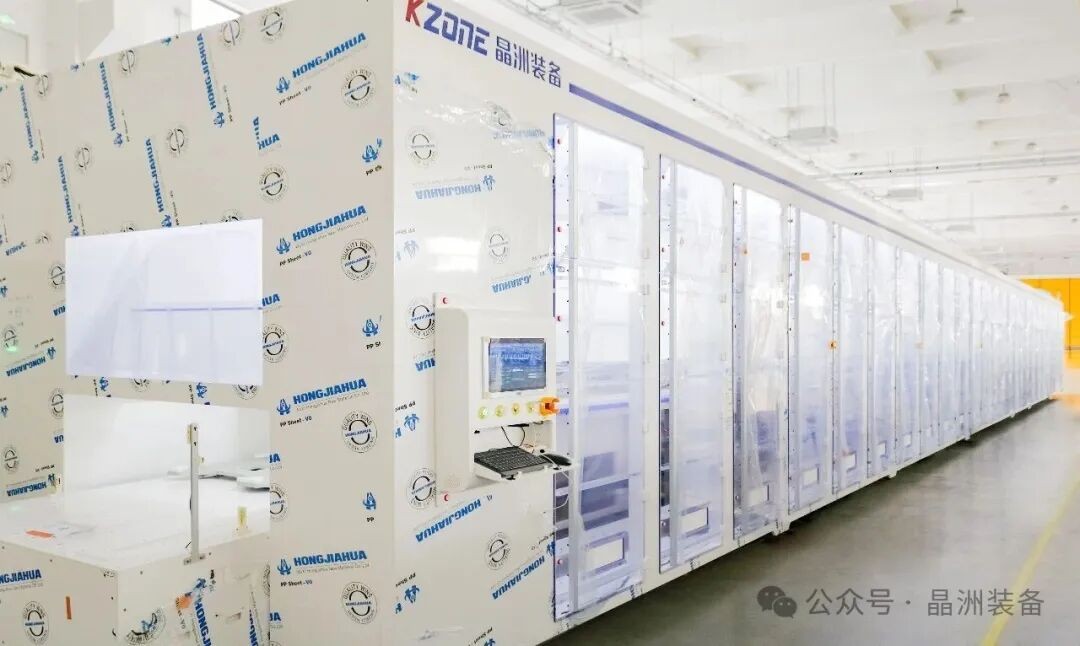

Wet processing equipment generally falls into one of two architectures. Batch equipment loads wafers into cassettes and immerses them together in a shared bath for a set dwell time, then moves the whole cassette to the next station. Inline (chain-type) equipment transports wafers continuously and individually through a sequence of process zones, with chemistry applied as a controlled film rather than a shared immersion bath. Neither architecture is universally better — each is suited to a different kind of process step, which is why a single TOPCon wet process line typically uses both.
Inline equipment is the right fit for steps that require single-side selectivity or continuous high-speed throughput with minimal wafer handling. Kzone uses chain-type inline platforms for Texturing, BSG Removal, and PSG Removal — steps where wafers move over precision etching rollers with a controlled liquid film applied to one face only, running at line speeds up to 5.0+ meters per minute in Kzone's integrated TOPCon line.
Batch equipment suits steps where both wafer faces need uniform, symmetric chemical exposure and where combining several sub-steps into one immersion sequence reduces handling risk. Kzone's Alkaline Polishing Cleaner uses a six-cassette batch configuration that combines alkaline polishing with RCA (SC-1/SC-2) cleaning in one system, since both steps benefit from full-immersion, symmetric processing rather than the single-side selectivity that inline equipment is built for.
Inline equipment generally offers higher throughput per unit of floor space for continuous, high-volume steps, since wafers never stop moving through the line. It also enables the single-side selectivity that BSG, PSG, and texturing recipes depend on. Batch equipment trades some of that continuous throughput for simpler, more uniform chemical exposure across both wafer faces, and for the ability to combine multiple related sub-steps — like polishing and RCA cleaning — into a single cassette sequence without extra wafer handling between them. Cost also differs: inline systems typically carry higher precision-engineering cost per station, while batch systems often cost less per station but require more cassette-handling infrastructure around them.
For a new TOPCon line, the architecture choice mostly follows the process step rather than a general preference for one approach over the other. Steps that require single-side etching — texturing, BSG removal, PSG removal — point toward inline equipment almost by default, since batch immersion can't achieve the same selectivity without an added masking step. Steps where both faces need uniform treatment, or where combining sub-steps reduces handling, point toward batch equipment. Most practical TOPCon lines end up using both architectures side by side, sized to a common throughput target rather than treating batch and inline as competing options for the same job.
Conclusion
Batch and inline wet processing equipment solve different problems rather than competing for the same one — inline for single-side, continuous, high-speed steps, batch for symmetric, multi-step immersion processing. Kzone's TOPCon/PERC Solution combines both architectures into a single integrated line, matched to a common throughput target. To review the full equipment lineup, explore Kzone's PV Industry Solutions, or contact Kzone's engineering team to discuss the right architecture mix for your line.