
TOPCon has become a leading technology for high-efficiency n-type solar cell production. Compared with conventional PERC technology, TOPCon offers higher conversion efficiency and a clear upgrade path for manufacturers looking to improve cell performance while leveraging much of their existing production infrastructure.
For manufacturers planning a new TOPCon production line, however, achieving high efficiency is not simply a matter of installing advanced deposition and metallization equipment. Wet processing—including texturing, cleaning, polishing, and silicon surface treatment—plays a critical role in wafer quality, process stability, and final cell yield.
This guide explains the main stages of TOPCon cell manufacturing, with a particular focus on wet process equipment and key considerations for large-scale production.
A TOPCon cell typically uses an n-type crystalline silicon wafer with a thin passivating oxide layer and a doped polysilicon layer on the rear surface. This structure enables effective carrier selectivity and reduces recombination losses at the silicon interface.
The combination of excellent surface passivation and low-contact resistance allows TOPCon cells to achieve higher efficiency than conventional PERC cells. At the same time, TOPCon is compatible with many established silicon wafer and cell manufacturing processes, making it attractive for manufacturers expanding or upgrading existing production capacity.
As the industry moves toward higher-efficiency n-type products, TOPCon has therefore become an important technology for both new cell factories and technology upgrades.
A typical TOPCon production line contains multiple interconnected processes, and the exact sequence may vary according to wafer type, cell architecture, and equipment configuration.
The production process generally includes wafer inspection and preparation, surface texturing, cleaning, diffusion or doping, oxide formation, polysilicon deposition, patterning or removal of unwanted layers, annealing, surface passivation, metallization, and firing.
Wet processes are mainly concentrated around wafer surface preparation and post-diffusion cleaning or removal steps. Their role is particularly important because subsequent deposition and passivation processes are highly sensitive to wafer surface conditions.
For a 1GW-class manufacturing facility, these processes must operate continuously with stable chemical concentration, temperature, flow rate, and wafer handling. Even small process variations can affect thousands of wafers and ultimately influence production yield.
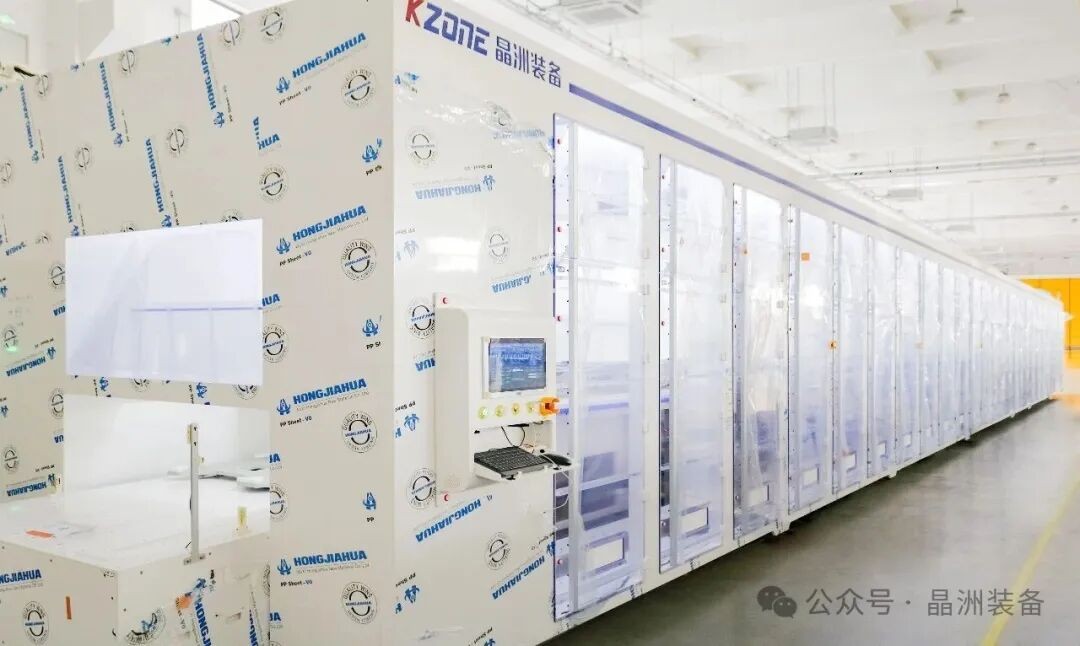
Wet process equipment is an essential part of TOPCon cell manufacturing because it directly determines the cleanliness and morphology of the silicon surface.
Texturing creates a microstructured surface that reduces optical reflection and improves light absorption. Uniform texture depth and morphology are important for maintaining consistent cell performance across the wafer.
After diffusion and doping, BSG/PSG removal is commonly required to eliminate unwanted boron- or phosphorus-containing glass layers. Effective removal must be achieved without damaging the silicon surface or creating excessive variation between wafers.
Polishing and surface treatment may also be incorporated into specific TOPCon process flows. These steps help control surface morphology and remove residual contamination or damaged layers when required by the cell architecture.
Finally, RCA cleaning and other chemical cleaning processes remove metallic contaminants, organic residues, and particles. High-quality cleaning is essential before critical deposition and passivation steps because surface contamination can reduce passivation quality and increase recombination.
For this reason, wet equipment should not be considered an isolated utility system. It is directly connected to the electrical performance and yield of the finished cell.
When designing a large-scale TOPCon production line, equipment selection should focus on more than nominal throughput.
Throughput and scalability are fundamental. The wet process system must match the capacity of upstream and downstream equipment without creating bottlenecks. A system designed for 1GW production should also provide sufficient flexibility for future capacity expansion.
Process uniformity is equally important. Chemical concentration, temperature, spray or immersion conditions, and wafer transport must remain stable throughout continuous operation. Poor uniformity can translate into variations in texturing, cleaning effectiveness, and cell efficiency.
Manufacturers should also evaluate chemical consumption, water usage, automation, maintenance requirements, and process control. Automated chemical dosing and monitoring can reduce operator dependence and improve long-term process consistency.
For an integrated solution covering TOPCon and PERC manufacturing requirements, manufacturers can explore the TOPCon/PERC Solution.
Wet processing problems can create significant yield losses even when other equipment performs correctly.
One common issue is non-uniform texturing, which may result from unstable chemical conditions, inadequate temperature control, or inconsistent wafer transport. Regular monitoring of process parameters is therefore essential.
Another major concern is incomplete cleaning or glass-layer removal. Residual BSG, PSG, particles, or metallic contamination can interfere with subsequent deposition and passivation processes.
Cross-contamination is another potential yield killer. Chemicals, tanks, rollers, and wafer handling systems need appropriate process separation and cleaning procedures. Equipment design should minimize chemical carryover between different process stages.
Finally, unstable chemical concentration or excessive chemical consumption can increase both operating costs and process variation. Automated dosing, filtration, temperature control, and real-time monitoring can help maintain a more stable production environment.
A high-performance TOPCon production line depends on the coordination of every process stage, from wafer preparation and texturing to deposition, passivation, and metallization. Within this system, wet process equipment provides the surface quality and cleanliness required for stable downstream processing.
For manufacturers planning a 1GW or larger TOPCon facility, the right equipment configuration should balance throughput, process uniformity, automation, chemical efficiency, and long-term scalability. A well-designed wet process system can help reduce yield losses while supporting consistent high-efficiency cell production.
If you are planning a new TOPCon production line or upgrading an existing cell manufacturing facility, contact Kzone Technology for a customized production line solution.