
Perovskite solar cells have attracted significant attention because of their high efficiency potential, low-temperature processing, and compatibility with large-area manufacturing. However, moving from laboratory-scale devices to commercial production requires more than improving the perovskite material itself. The coating process must also deliver consistent film quality across increasingly large substrates.
This is where precision perovskite solar cell coating becomes critical. Compared with laboratory techniques such as spin coating, continuous coating technologies can provide better material utilization, process control, and scalability. Among these technologies, slot-die coating has emerged as a practical approach for producing uniform perovskite films over larger areas.
The performance of a perovskite solar cell is highly dependent on the quality of its functional layers. The perovskite absorber must have controlled thickness, good surface coverage, and consistent crystallization characteristics. Any significant variation can lead to differences in light absorption, charge transport, and device efficiency.
Solution-based coating offers an attractive alternative to vacuum-based deposition for many perovskite manufacturing processes. The coating solution can be applied directly to the substrate and processed through subsequent drying or annealing steps.
However, solution processing also introduces challenges. Solvent evaporation, fluid flow, substrate movement, and coating conditions can all influence the final film. Precision coating equipment is therefore essential for maintaining stable perovskite coating quality as production scales.
Spin coating is widely used during laboratory research because it is relatively simple and effective for producing thin films on small substrates. The substrate rotates at high speed while the coating solution spreads across the surface through centrifugal force.
For commercial-scale manufacturing, however, spin coating has several limitations. Material utilization can be relatively low, and coating a large substrate uniformly becomes increasingly difficult. It is also fundamentally a batch-oriented process.
Slot-die coating works differently. The coating solution is delivered through a precision slot onto a moving substrate, creating a continuous wet film. This makes the process more suitable for large-area substrates and continuous manufacturing.
Slot-die coating can also provide better control over material usage because the coating volume can be accurately metered. When combined with automated substrate handling and process monitoring, it provides a practical route toward scalable perovskite production.
Successful perovskite solar cell coating depends on maintaining several process parameters within a controlled range.
Film thickness directly affects optical absorption and the electrical properties of the finished device. Excessive or insufficient coating thickness can reduce cell performance, so the coating system must provide precise liquid delivery.
Film uniformity is equally important, particularly as substrate dimensions increase. Variations across the coating width can create local differences in perovskite crystallization and electrical performance.
Substrate speed must also be coordinated with coating flow rate and solution properties. If the substrate moves too quickly or too slowly relative to the liquid supply, coating thickness and surface quality may become unstable.
Other variables, including solution viscosity, surface tension, temperature, nozzle-to-substrate distance, and drying conditions, can also influence the final coating. These parameters should be considered as an integrated process rather than adjusted independently.
The transition from laboratory cells to module-scale manufacturing introduces a major change in process requirements. A coating method that works well on a small glass substrate may not automatically produce the same results across a much larger surface.
As substrate size increases, maintaining consistent liquid distribution becomes more challenging. Edge effects, fluid instability, drying behavior, and environmental conditions can all affect film quality.
Slot-die coating provides a scalable solution because coating width, liquid flow, and substrate movement can be engineered according to production requirements. The same basic coating principle can therefore be adapted from experimental equipment to larger manufacturing systems.
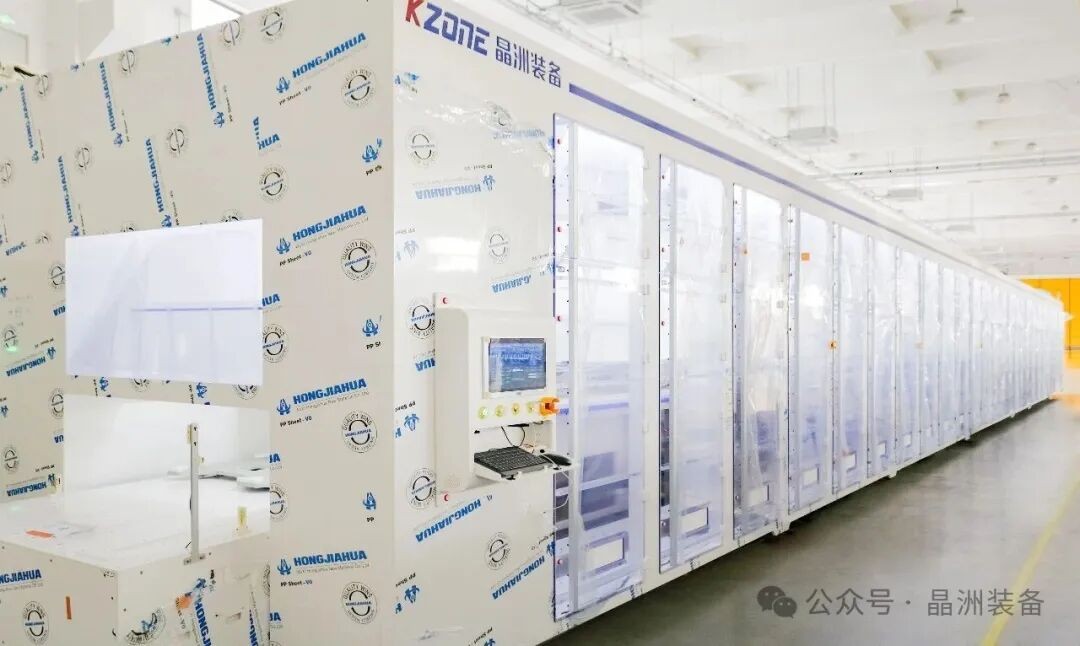
For manufacturers evaluating dedicated coating solutions, Kzone Technology's Perovskite Coater is designed to support precision coating requirements for perovskite applications.
A reliable perovskite coating system requires more than a precision coating head. The entire equipment platform needs to maintain stable process conditions throughout production.
The liquid delivery system should provide accurate and consistent flow, while the coating head must maintain a controlled gap and coating profile. Substrate transport also needs precise speed control to prevent fluctuations in film thickness.
Environmental control can be particularly important for perovskite processing. Temperature and humidity may influence solvent evaporation, wet-film formation, and crystallization behavior. Depending on the process chemistry, an enclosed or controlled coating environment may therefore be beneficial.
Automation and monitoring are also important for production-scale systems. Sensors and process controls can track parameters such as coating speed, liquid flow, temperature, and other operating conditions. This allows manufacturers to identify process deviations earlier and maintain more consistent output.
Equipment should also be designed with production efficiency in mind, including easy cleaning, repeatable setup, stable operation, and compatibility with upstream and downstream processes.
The commercialization of perovskite solar technology depends not only on material development but also on scalable manufacturing processes. Precision perovskite coating is a critical part of this transition because film thickness, uniformity, and coating stability directly influence device performance.
While spin coating remains valuable for laboratory research, slot-die coating offers clear advantages for large-area and continuous production. With accurate liquid delivery, controlled substrate movement, environmental management, and automated process monitoring, slot-die technology can help bridge the gap between laboratory-scale perovskite cells and industrial manufacturing.
For companies evaluating coating solutions for perovskite solar cell production, contact Kzone Technology to discuss your coating equipment and process requirements.