
Slot-die coating, also called slit coating, is a precision liquid deposition method that pumps a functional fluid through a narrow, engineered slot in a die head and deposits it as a continuous, uniform wet film onto a moving substrate. Unlike spray or dip coating, which rely on atomization or immersion, slot-die coating forms the film directly from a controlled bead of liquid held in the gap between the die lip and the substrate — a method that gives much tighter control over film thickness and uniformity across the full web width.
The basic principle is straightforward: fluid is metered at a precise, constant flow rate into the die head, which distributes it evenly along its internal manifold before it exits through the slot as a thin curtain. As the substrate moves beneath the die at a controlled speed, this curtain transfers onto the surface and stabilizes into a wet film whose thickness is set by the balance between flow rate, substrate speed, and the coating gap. Because the process doesn't rely on gravity, spray dynamics, or substrate wetting behavior the way some other coating methods do, it's well suited to fluids with a wide range of viscosities and to substrates that require very tight film-thickness tolerances.
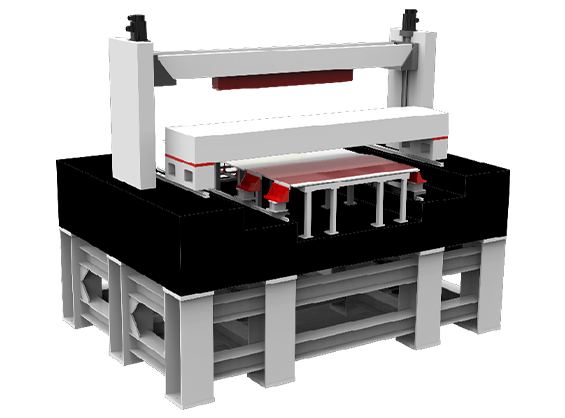
A slot-die coating system is built around three tightly interdependent subsystems:
● Die head — precision-machined to distribute fluid evenly across its internal manifold before it reaches the slot opening. Manifold design (often a "coat-hanger" profile) is what determines whether flow — and therefore film thickness — stays uniform across the full substrate width rather than favoring the center or edges.
● Pump system — typically a precision syringe or gear pump capable of extremely stable, pulsation-free flow. Even small flow fluctuations translate directly into thickness variation along the length of the coated film, so pump stability is often the single largest factor in longitudinal uniformity.
● Substrate conveying — the mechanism that transports the substrate under the die at a controlled, consistent speed, whether that's a moving web in roll-to-roll production or a motorized stage for sheet-to-sheet processing. Speed stability and the substrate's flatness as it passes under the die both directly affect coating gap consistency.
A handful of interdependent parameters determine whether a slot-die coating process produces a stable, uniform film or runs into defects:
● Flow rate — sets the wet film thickness in combination with substrate speed and coating width; needs to be held extremely stable to avoid streaking or thickness drift.
● Coating gap — the distance between the die lip and the substrate; too large a gap destabilizes the liquid bead, too small risks contact with the substrate or die wear.
● Substrate (web) speed — works together with flow rate to set film thickness, and has to stay synchronized with flow changes during speed ramp-up or ramp-down to avoid transient thickness errors.
● Fluid viscosity and surface tension — determine the coating window (the combination of speed and flow rate over which a stable bead can be maintained) and how easily the process can produce very thin films without breaking up.
● Meniscus (coating bead) stability — the liquid bridge between the die lip and substrate has to remain stable throughout the run; instability here is the direct cause of most streaking, ribbing, and edge defects.
Slot-die coating has become one of the leading deposition methods for perovskite photovoltaic cells, where it's used to deposit the perovskite absorber layer and adjacent charge-transport layers with the thickness precision and low material waste that spin coating can't match at production scale. Because it can run in a roll-to-roll or large-area sheet format, it's also a natural fit for scaling perovskite technology from lab-scale devices to commercial module sizes.
In display manufacturing, slot-die coating is used to deposit functional layers such as planarization coatings, hard coats, and certain OLED and QD (quantum dot) layers, where uniformity across large substrate areas is critical to visual consistency. Beyond PV and display, the same core technology is widely used for battery electrode coating, functional and barrier films, and other applications where a uniform, well-controlled wet film needs to be applied continuously at production speed.
A few criteria matter more than nominal specifications when assessing whether a slot-die coater will hold performance at production volume:
● Coating window width — how much tolerance the system has in speed and flow rate before defects appear, which determines how forgiving the process is to material or process variation.
● Cross-web uniformity — thickness consistency from edge to edge, not just at the center of the substrate, which depends heavily on die manifold design.
● Flow and speed synchronization during transients — how well the system holds thickness during startup, shutdown, and speed changes, which matters for minimizing scrap in continuous production.
● Die cleaning and changeover time — how easily the die head can be cleaned or swapped between material formulations, which affects changeover cost in multi-product lines.
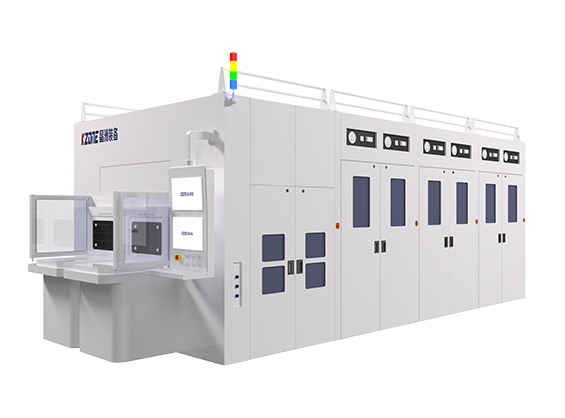
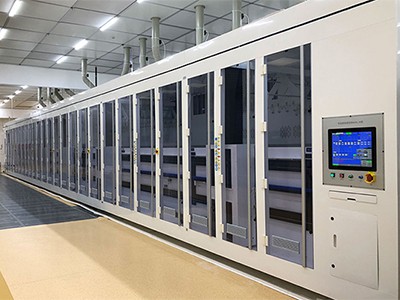
Kzone's Perovskite Coater is built around these considerations, with a die head and pump system engineered specifically for the flow stability and cross-web uniformity that perovskite and functional-film coating applications require.
Slot-die coating's precision comes from how tightly its core parameters — flow rate, coating gap, substrate speed, and fluid properties — interact, which is also why equipment design matters as much as the chemistry of the coating fluid itself. To review specifications for a production-scale slot-die system, see Kzone's Perovskite Coater or contact Kzone's engineering team to request a detailed equipment spec sheet for your application.